Made for Founders
Fabric for founders
Investor conversations, product decisions, hiring notes, competitive intel, and strategy docs. AI that remembers everything so you don't have to.
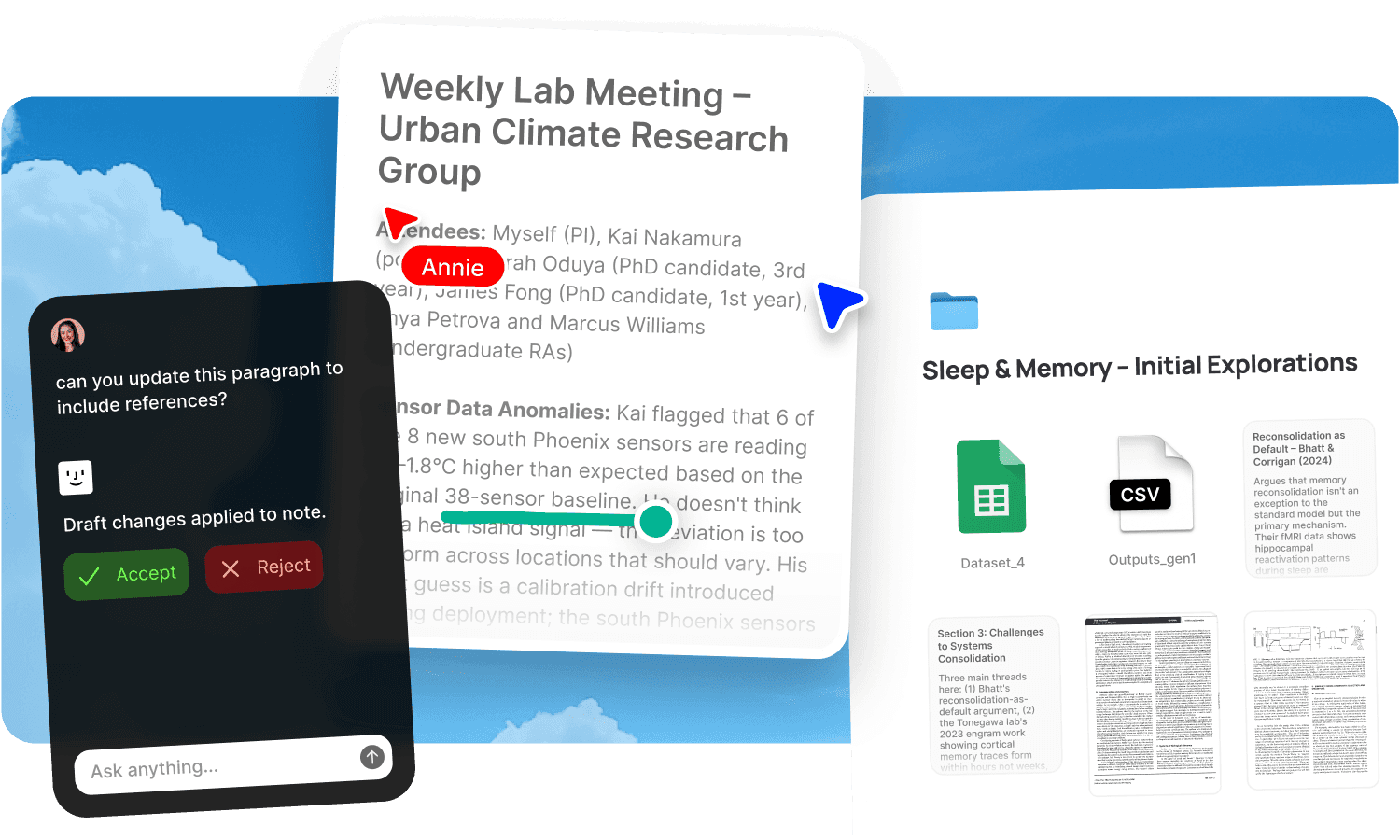
A founder's head holds more context than any tool is designed to capture. The investor who asked about unit economics last Tuesday. The product decision that changed the roadmap. The competitive move you noticed and told yourself to track. The candidate you liked but weren't ready to hire. The customer call where the real objection surfaced. All of this matters, and all of it lives in a fragile mix of memory, scattered notes, email threads, and Slack messages that you'll never scroll back to. You're the person who has to connect the fundraise to the product to the market to the team, and the system for holding all of that together is usually your brain, which is already full.
Fabric is a founder's operating system: one searchable place for every decision, conversation, insight, and document, with an AI that remembers the full picture so you can think about what's next instead of reconstructing what happened.
Everything you know, searchable
Founders accumulate context across every part of the business. Product specs, investor updates, hiring notes, customer call recordings, competitive screenshots, board materials, strategy docs, go-to-market plans. Each lives in whatever tool was closest when you created it. None of them can see the others.
Fabric holds all of it in one library. AI search reads inside every document, note, recording, and email, and finds things by meaning. Ask "what did we decide about pricing at the offsite" and find the meeting transcript, the follow-up note, and the updated model together. Ask "what has [competitor] been doing with their enterprise offering" and find the screenshots, articles, and call notes you've saved over the past six months.
The AI assistant synthesises across your library. Ask it to prepare you for a board meeting by pulling together metrics, product progress, and competitive updates from across months of material. Ask it what you've discussed with a specific investor across every meeting. The AI holds the full picture that your memory can't.
Investor relations without the scramble
Fundraising creates its own parallel workstream: pitch decks, financial models, term sheets, due diligence documents, investor meeting notes, and follow-up emails. Every investor conversation generates context that matters for the next one, and losing track of who said what at which stage costs you credibility.
Create a space per investor or per round. Record meetings with AI voice notes and the transcripts are searchable. Forward investor emails to email-to-note. When you need to remember what a specific investor asked about three weeks ago, search for it rather than scrolling through your inbox.
Publish your deck, data room, or investor update with password protection and link analytics. Create individually named tracking links per investor. Know who has reviewed the materials and follow up with signal rather than silence. For the full diligence workflow, see data room.
Decisions that stay found
The most expensive thing a founder loses isn't a file. It's the reasoning behind a decision. Why you chose this architecture. Why you priced it that way. Why you passed on that candidate. The decision was made, the context was clear at the time, and three months later the context is gone and someone is asking you to justify it.
Fabric captures decisions as a byproduct of the work. Meeting transcripts, notes, and documents accumulate in your workspace. When someone asks "why did we do it that way," AI search finds the meeting where it was discussed, the note where the rationale was written, and the research that informed it. The decisions are retained without you maintaining a separate decision log.
Write strategy notes, product memos, and thinking-in-progress in notes and docs. They're searchable alongside everything else, so your own thinking is as findable as the external material.
Competitive awareness that compounds
Every founder tracks competitors, but few do it systematically. You screenshot a pricing page, save an article about their funding round, and take notes after a sales call where a prospect mentioned them. Within a month, the intelligence is scattered and the picture has faded.
Save competitive material to Fabric and it stays searchable forever. AI search reads text inside screenshots and images. The AI assistant can summarise what you've collected about any competitor, compare two competitors on a specific dimension, or surface changes you've tracked over time. The competitive library compounds rather than resetting. See competitive research for the full workflow.
Use cases for founders
The workflows founders run in Fabric: capturing meeting notes from every call, managing investor relations and data rooms, tracking competitive research and market research, running a lightweight CRM for deals and prospects, sharing sales collateral with tracked links, hosting a press kit behind one link, brainstorming strategy on the canvas, content planning for thought leadership and marketing, and building a second brain that holds everything you read, think, and learn.
A founder's day in Fabric
Before breakfast. You scan your inbox and forward two important emails to email-to-note: an investor's follow-up question and a customer's feature request. Both land in your workspace, searchable alongside everything else.
Morning. You have a board prep session. You ask the AI assistant to pull together this quarter's key metrics, product milestones, competitive moves, and open hiring. It synthesises from across your workspace and you have a draft board memo in minutes.
Mid-morning. An investor call. You recorded the last one with voice notes, so before this one you search "what did [investor] ask about last time." The AI finds the exact question about customer concentration from the transcript. You walk in prepared.
Lunch. You notice a competitor launched a new product. You screenshot the landing page and save it. Next time someone asks about the competitive landscape, it's already in the library alongside everything else you've tracked.
Afternoon. You're writing a strategy memo. You draft in notes and docs with your market research, customer call notes, and competitive analysis all searchable alongside the draft. The memo is grounded in evidence, not just opinion.
End of day. You share the updated pitch deck with three investors via tracked links. You move a prospect to the next stage on the kanban. You add a task to follow up with the candidate you met yesterday.
Get started
Build a personal operating system where every decision, conversation, and insight is searchable. Try Fabric free.
For your team's shared workspace, see Fabric for startups. For solo builders without a team yet, see Fabric for indie hackers. For investors on the other side of the table, see Fabric for investors.
FAQs
Can the AI remember what was discussed in past meetings?
Yes. Record meetings with AI voice notes and the transcripts are searchable. The AI assistant can recall what was discussed in any meeting, summarise conversations with a specific person across multiple meetings, or pull together context before your next call.
Can I search across everything in my workspace at once?
Yes. AI search reads inside every document, note, recording, screenshot, and email in your workspace and searches by meaning. One search bar for your entire operating context.
Can I track investor engagement with my deck?
Yes. Publish with password protection and link analytics. Create named tracking links per investor and see who opened the deck, how long they spent, and which sections they viewed.
Can I set up a data room for fundraising?
Yes. Share diligence documents with password-protected, tracked links. See the full data room workflow.
Can I track competitive intelligence over time?
Yes. Save screenshots, articles, and notes about competitors. AI search reads text inside images. The library grows into a timeline of each competitor's evolution. See competitive research.
Can the AI prepare me for a board meeting?
Yes. Ask the AI assistant to synthesise across your workspace: metrics, product updates, competitive moves, hiring progress, and open questions. It pulls context from months of material.
Can I use Fabric as a lightweight CRM?
Yes. Create a space per prospect with call notes, proposals, and tasks. See the CRM use case.
Can I forward emails into my workspace?
Yes. Forward any email to your email-to-note address and it becomes a searchable item alongside your notes and documents.
Can I capture ideas on my phone between meetings?
Yes. The mobile app and quick capture let you record a voice note, jot a thought, or save a link in seconds. Everything syncs to your workspace.
Can I write strategy memos alongside my research?
Yes. Draft in notes and docs with your market research, competitive analysis, and customer call notes searchable alongside. The memo stays connected to the evidence behind it.
Can I use Fabric alongside my existing tools?
Yes. Fabric connects to Google Drive, Dropbox, Notion, and Gmail. It works alongside your CRM, PM tools, and communication apps.
Is my data secure?
Yes. Fabric uses AES-256 encryption, is CASA Tier 2 compliant, and does not use your data to train AI models. Investor materials, competitive intel, and strategy docs are private by default.
How is this different from just using Notion?
Notion is a page-based tool that requires deliberate structure. Fabric holds every content type (documents, recordings, screenshots, emails, PDFs) and makes all of it searchable by meaning, with an AI that synthesises across the full history. The difference matters when you need to find "what we decided about X" and the answer is in a meeting transcript, not a wiki page.