Made for Indie Hackers
Fabric for indie hackers
Product research, competitor analysis, user feedback, and launch plans. A second brain that scales with your ambition.
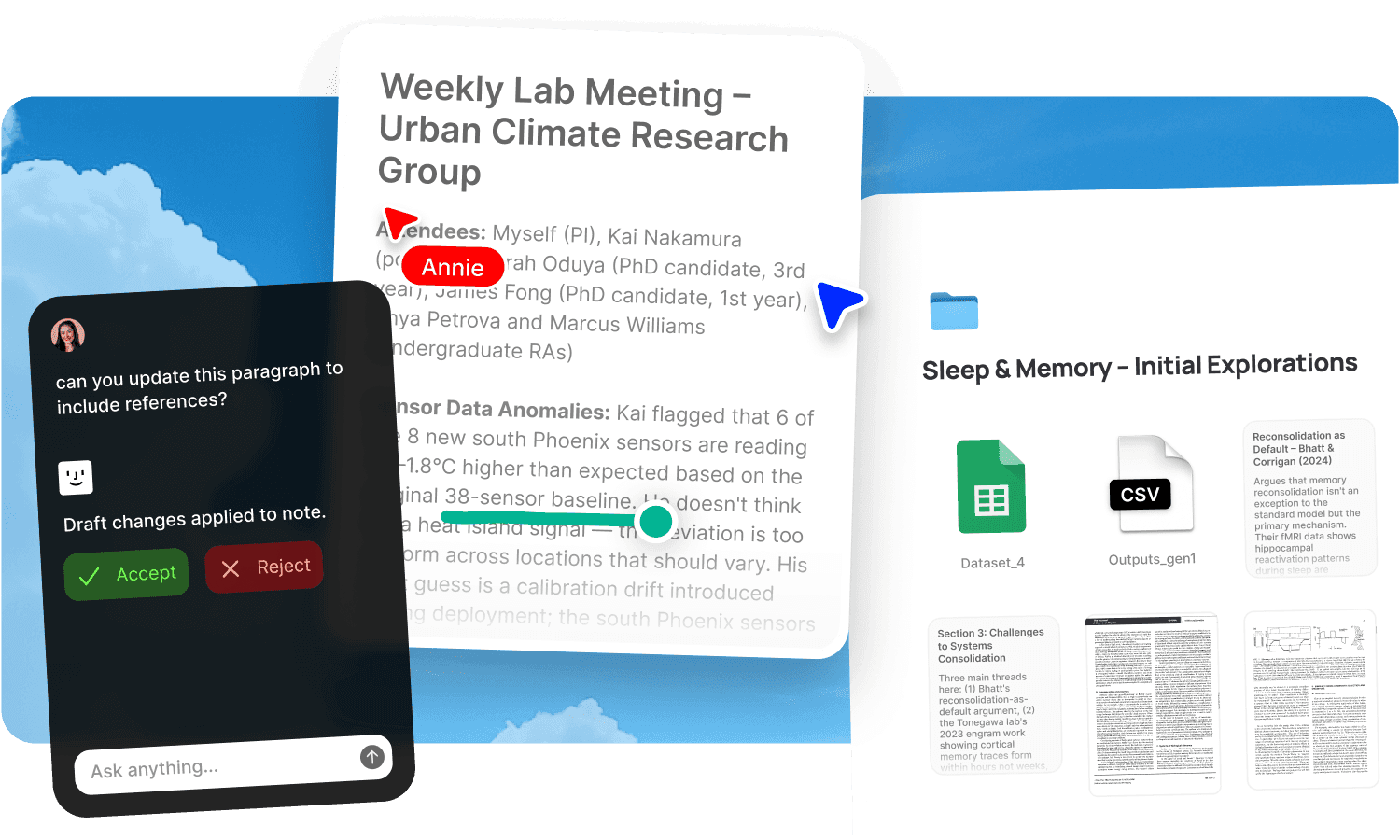
Building alone means holding everything alone. You're the researcher, the product thinker, the designer, the marketer, the support team, and the builder. The market analysis that informed the pivot lives in a Google Doc. The user feedback that shaped the feature lives in email. The competitor's pricing page you screenshotted lives on your desktop. The launch plan lives in your head. The technical reference you bookmarked three months ago lives in a browser you've since closed. Every aspect of the product has context behind it, and that context is scattered across so many places that the only system connecting it all is your memory, which is already overloaded by the fact that you're also writing the code.
Fabric is the second brain for solo builders: one searchable workspace where product research, competitor intelligence, user feedback, technical references, and your own thinking all live together, with an AI that connects them.
Your entire product context, searchable
An indie hacker's research doesn't look like anyone else's. It's a mix of Hacker News threads, competitor landing pages, customer emails, forum posts, podcast episodes, blog articles, your own notes, and screenshots of analytics dashboards. Each piece feeds the product in some way, and none of them know about each other.
Fabric holds all of it. AI search reads inside every document, note, screenshot, and transcript and searches by meaning. Ask "what did users say about the pricing" and find the email, the survey response, and your own note from the support conversation, together. Ask "how does [competitor] handle onboarding" and find the screenshots, the article, and the notes you took from their demo.
The AI assistant synthesises across your library. Ask it to connect your market research to your product decisions, summarise what you've learned about a customer segment, or pull together every data point on a specific feature question. It works from your material, so the answers are grounded in what you've actually gathered.
Track competitors without a process
You don't have a competitive intelligence team. You have a habit of saving things when you notice them. A competitor launches a feature, you screenshot it. They raise a round, you save the article. A prospect mentions them on a call, you note it. The intelligence accumulates informally, and informally means it scatters.
Save everything to Fabric as you encounter it. AI search reads text inside screenshots and images, so a captured pricing page is as searchable as a typed note. Over months, the competitive library grows into a timeline of each competitor's moves. Ask the AI assistant to summarise what you know about a competitor, compare two competitors on a feature, or identify gaps in your intelligence.
The library compounds without you maintaining it. Six months of informal captures becomes a genuinely useful competitive resource. See competitive research for the full workflow.
Ideas and decisions that don't evaporate
Solo builders make dozens of product decisions a week, and most of the reasoning evaporates. Why you built it that way. Why you chose this pricing model. Why you passed on that feature request. The decision made sense at the time, and three months later you're re-debating it because the context is gone.
Capture your thinking in notes and docs. Record a voice note when typing feels like too much. Forward your own thinking-out-loud emails to email-to-note. Jot a thought with quick capture on your phone. Every fragment of reasoning enters the same searchable workspace.
When you revisit a decision, search for it. The reasoning is there. When you're writing a launch post and need to articulate why you built something, the thinking is findable, not reconstructed from memory.
Stay current without drowning
Indie hackers consume a lot: blog posts, podcasts, Twitter threads, Hacker News discussions, newsletters, YouTube videos, technical documentation. The best ideas come from connecting what you read to what you're building, but the reading and the building happen in different mental spaces, and the connections only form if you can search across both.
Subscribe to relevant sources with RSS feeds and they arrive in your workspace alongside everything else. Save articles with the web clipper. Forward newsletters to email-to-note. Record takeaways from podcasts as voice notes. The consumption feeds the same library as the product work, so the article you read about retention strategies is searchable when you're designing your onboarding flow.
The AI assistant connects reading to building. Ask "what have I read about reducing churn in B2B SaaS" and it pulls together articles, notes, and your own thinking from across your library. See reading and learning for the full personal library workflow.
Use cases for indie hackers
The workflows indie hackers run in Fabric: building a second brain for product knowledge that compounds, tracking competitive research informally, conducting market research with AI synthesis, content planning for building in public and marketing, brainstorming product direction on the canvas, capturing meeting notes from user calls, running a lightweight CRM for early sales conversations, sharing launch materials with tracked links, hosting a press kit behind a permanent link, and maintaining a reading library of everything you consume.
An indie hacker's day in Fabric
Morning. You scan your RSS feeds and newsletters in Fabric. An article about conversion optimisation catches your eye. You save it and ask the AI assistant to connect it to your own notes about your signup flow. It pulls together the article, your analytics observations, and two user feedback emails.
Mid-morning. You have a call with a potential customer. You record it with voice notes. They mention a competitor's approach to pricing. You save a note. Later, you search "pricing" and find this conversation alongside the competitor screenshots and the pricing model notes from last month.
Afternoon. You're deciding whether to build a feature. You search for every piece of user feedback that mentions the problem the feature would solve. The AI assistant synthesises across five user emails, three support conversations, and your own notes. You make the decision with evidence.
Evening. You're writing a build-in-public post. You draft in notes and docs with your research, user quotes, and competitive context searchable alongside. The post is grounded in specifics.
Late night. An idea hits. You record a voice note on your phone. Thirty seconds. Tomorrow it'll be transcribed, searchable, and waiting for you alongside everything else.
Get started
Build a second brain for your product and stop losing the context that connects your research to your decisions. Try Fabric free.
For founders managing a team and investors, see Fabric for founders. For your team's shared workspace when you're ready to hire, see Fabric for startups. For the general developer workflow, see Fabric for developers.
FAQs
Can I search across all my product research at once?
Yes. AI search reads inside every document, note, screenshot, email, and transcript in your workspace and searches by meaning. One search bar for your entire product context.
Can the AI connect what I've read to what I'm building?
Yes. The AI assistant draws on your full library: articles, user feedback, competitive intelligence, and your own notes. Ask it to connect a concept from an article to a product decision and it synthesises across sources.
Can I track competitors without a formal process?
Yes. Save screenshots, articles, and notes as you encounter them. AI search reads text inside images. Over time, the captures grow into a searchable competitive library. See competitive research.
Can I record user calls and search them later?
Yes. AI voice notes capture and transcribe calls. The transcript is searchable by meaning. Find what a user said about a specific feature or problem without re-listening.
Can I capture ideas quickly on my phone?
Yes. Quick capture and the mobile app let you record a voice note, type a thought, or save a link in seconds. Everything syncs to your workspace.
Can I follow blogs and newsletters in Fabric?
Yes. Subscribe to sources with RSS feeds. Forward newsletters to email-to-note. Content arrives in your workspace alongside your product research.
Can I use Fabric for early sales conversations?
Yes. Create a space per prospect with call notes, proposals, and follow-ups. Use kanban to visualise your pipeline. See the CRM use case.
Can I share my product with tracked links?
Yes. Publish demos, landing pages, pitch materials, or documentation with link analytics. See who's engaged and follow up accordingly.
Can I use the canvas for product planning?
Yes. The canvas lets you spread ideas, user feedback, competitive screenshots, and product concepts spatially. Useful for roadmap planning, feature prioritisation, or brainstorming.
Can I write and publish content from Fabric?
Yes. Draft build-in-public posts, launch announcements, and marketing content in notes and docs with your research searchable alongside. Publish directly from Fabric with a shareable link.
Is this different from using Notion as a solo founder?
Notion is a page-based tool that requires deliberate structure. Fabric holds every content type (screenshots, recordings, emails, PDFs, articles, notes) and makes all of it searchable by meaning, with an AI that synthesises across your full library. The difference matters when your context spans dozens of sources in different formats and you need to find or connect things quickly.
Is my product data secure?
Yes. Fabric uses AES-256 encryption, is CASA Tier 2 compliant, and does not use your data to train AI models. Product research, user feedback, and competitive intelligence are private by default.