Made for engineering teams
Engineering docs that write themselves
Architecture decisions, API docs, migration notes, and system overviews, assembled from your PRs, discussions, and standups.
Documentation that stays current because it writes itself.
Your docs are stale because writing docs competes with writing code, and code always wins. The architecture decision was discussed in a PR comment. The migration plan was hashed out in Slack. The system overview was accurate six months ago. Nobody has time to update any of it because the sprint is full, and the choice between shipping a feature and updating a wiki page isn't really a choice. So the docs rot, new engineers spend their first week asking questions that should be answered by documentation, and the team's knowledge lives in the heads of the people who happened to be there when the decisions were made.
Fabric connects to GitHub, Slack, and your meetings, and self-writing docs produce engineering documentation from your actual PRs, technical discussions, and standups. Docs appear within 24 hours and update continuously as your team ships.
Self-writing engineering docs
Self-writing docs connect to your team's daily activity and produce the documentation nobody has time to write:
Engineering docs covering architecture decisions, API documentation, migration notes, and system overviews, assembled from PRs, code reviews, and technical discussions in Slack. When someone merges a PR that changes how auth works, the docs reflect it without anyone opening a wiki.
A decision log capturing technical decisions as they're made: why you chose this database, why you deprecated that endpoint, why the migration was scoped the way it was. The reasoning is preserved alongside the decision.
A changelog tracking what shipped, when, and why. Assembled from merged PRs and release activity, ready to post or share.
The docs reflect what was built. Not what someone remembered to write about three sprints later.
AI search across your full engineering context
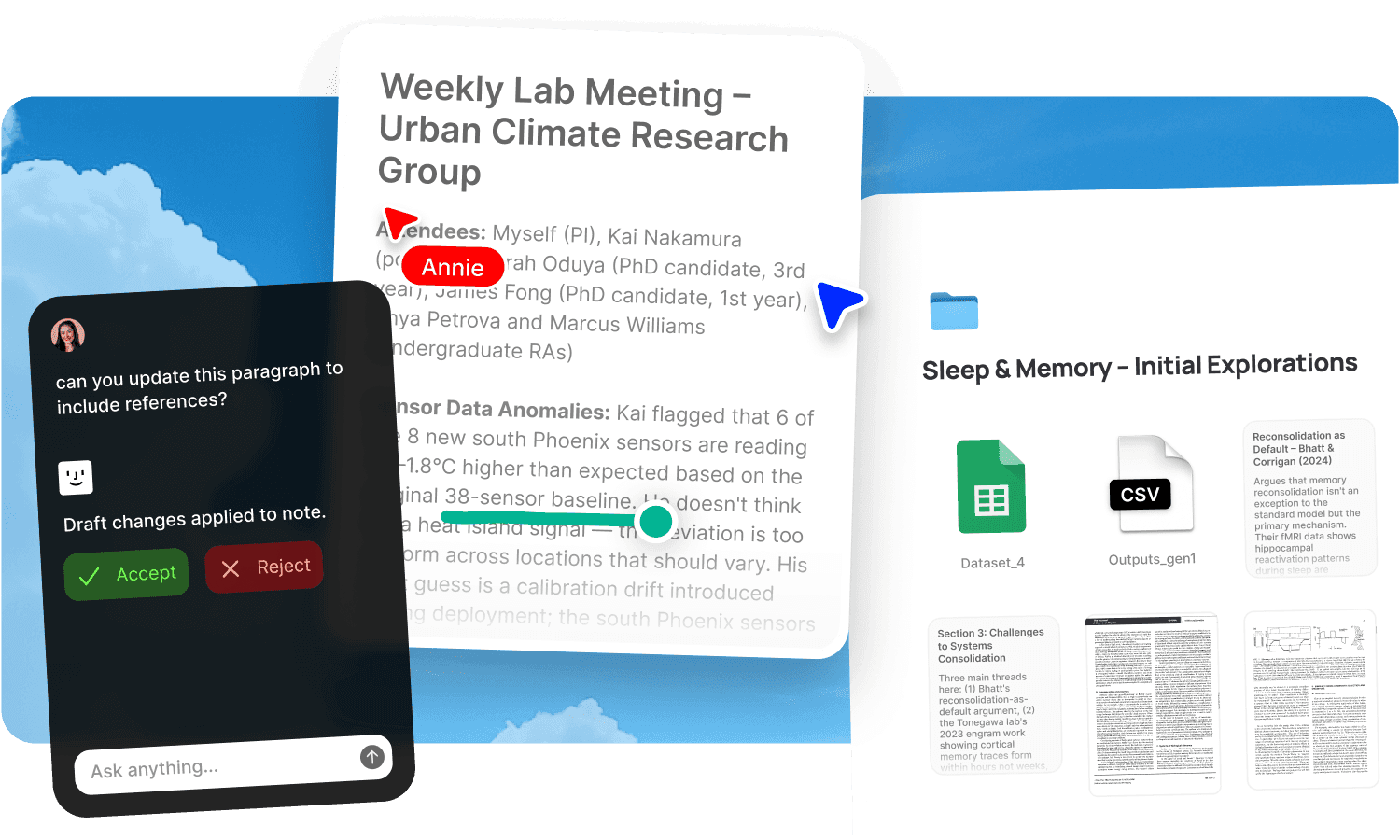
AI search lets anyone type "how does auth work for the billing service" and get a cited answer drawn from docs, Slack history, and meeting transcripts, linked to the exact source. The search works by meaning, so "how do we handle rate limiting" finds the relevant Slack thread, the PR where it was implemented, and the architecture doc, even if none of them use the phrase "rate limiting" in the title.
The AI assistant synthesises across sources. Ask it to explain a system's architecture drawing from docs and discussions, trace the history of a technical decision, or find every conversation about a specific service. It cites the sources it draws from.
New engineers stop asking questions that interrupt senior engineers. They search, they get cited answers, and they ramp faster because the knowledge base is already built from the team's actual work.
Agents that move tickets, update docs, and post changelogs
Agents don't just find information. They act on it:
One reads your standup notes and moves the relevant Linear tickets to the right status.
Another watches merged PRs and updates the project roadmap with what actually shipped.
Another drafts the weekly engineering changelog and posts it to Slack, assembled from the week's merged PRs and completed tickets.
The busywork that used to fall through the cracks gets handled automatically. Engineers stay in their editor.
Onboarding that doesn't depend on one person
When a new engineer joins, they inherit a searchable knowledge base covering every architecture decision, system overview, and technical discussion the team has ever had. They ask the AI assistant "how does our payment processing work" and get a cited answer drawn from docs, Slack, and meeting transcripts. No week-long ramp of interrupting senior engineers with questions that have been answered before.
The self-writing docs produce onboarding documentation that stays current as systems change. The onboarding guide reflects the actual state of your stack, not a snapshot from when someone last had time to update it.
For structuring the onboarding experience, see onboarding new team members.
Who on the team uses Fabric
Developers search across technical context and documentation. Product managers track project documentation and decisions. Founders and startups use self-writing docs to build documentation that scales with the team. Indie hackers document solo product decisions for their future selves.
Get started
Give your engineering team documentation that writes itself from the work you're already doing. Try Fabric free. See pricing for teams.
FAQs
How do self-writing docs work for engineering?
Self-writing docs connect to your GitHub, Slack, and meetings. They assemble architecture docs, API documentation, and system overviews from your PRs, code reviews, and technical discussions. Docs appear within 24 hours and update as your team ships.
Can anyone search across Slack, GitHub, and meeting transcripts at once?
Yes. AI search connects to your tools and searches across everything by meaning. Answers are cited with links to the exact source.
Can agents move Linear tickets from standup notes?
Yes. Agents can read standup notes and move the relevant tickets to the right status in your project tracker.
Can agents draft the weekly changelog?
Yes. An agent assembles the changelog from merged PRs and completed tickets and posts it to Slack, ready for review.
Do the docs stay current as the codebase changes?
Yes. Self-writing docs update continuously from your team's activity. When a PR changes how a system works, the documentation reflects it without anyone manually editing a wiki page.
Can new engineers search the full technical history?
Yes. The full history of architecture decisions, technical discussions, and system documentation is searchable from day one. New hires ramp faster because the knowledge base already exists.
Does the decision log capture why, not just what?
Yes. The decision log captures the reasoning from the meetings and discussions where decisions were made, not just the outcome. When someone asks "why did we choose Postgres over Mongo," the context is there.
What tools does Fabric connect to?
Fabric connects to GitHub, Slack, Linear, Google Drive, Notion, Gmail, and meeting tools. See connections for the full list.
Is our code and technical data secure?
Yes. Fabric uses AES-256 encryption and is CASA Tier 2 compliant. Your team's data is never used to train AI models.
How is this different from a wiki like Confluence or Notion?
Wikis require someone to write and maintain the docs. Nobody does, so the docs rot. Fabric's self-writing docs produce themselves from your GitHub activity, Slack threads, and meeting transcripts. The documentation stays current because it's assembled from what your team is already doing, not from a separate writing task that competes with shipping code.