Roadmap context, feature decisions, user feedback synthesis, and spec evolution.
Assembled from your meetings, Slack discussions, and product spaces. Always current because it updates as your team works.
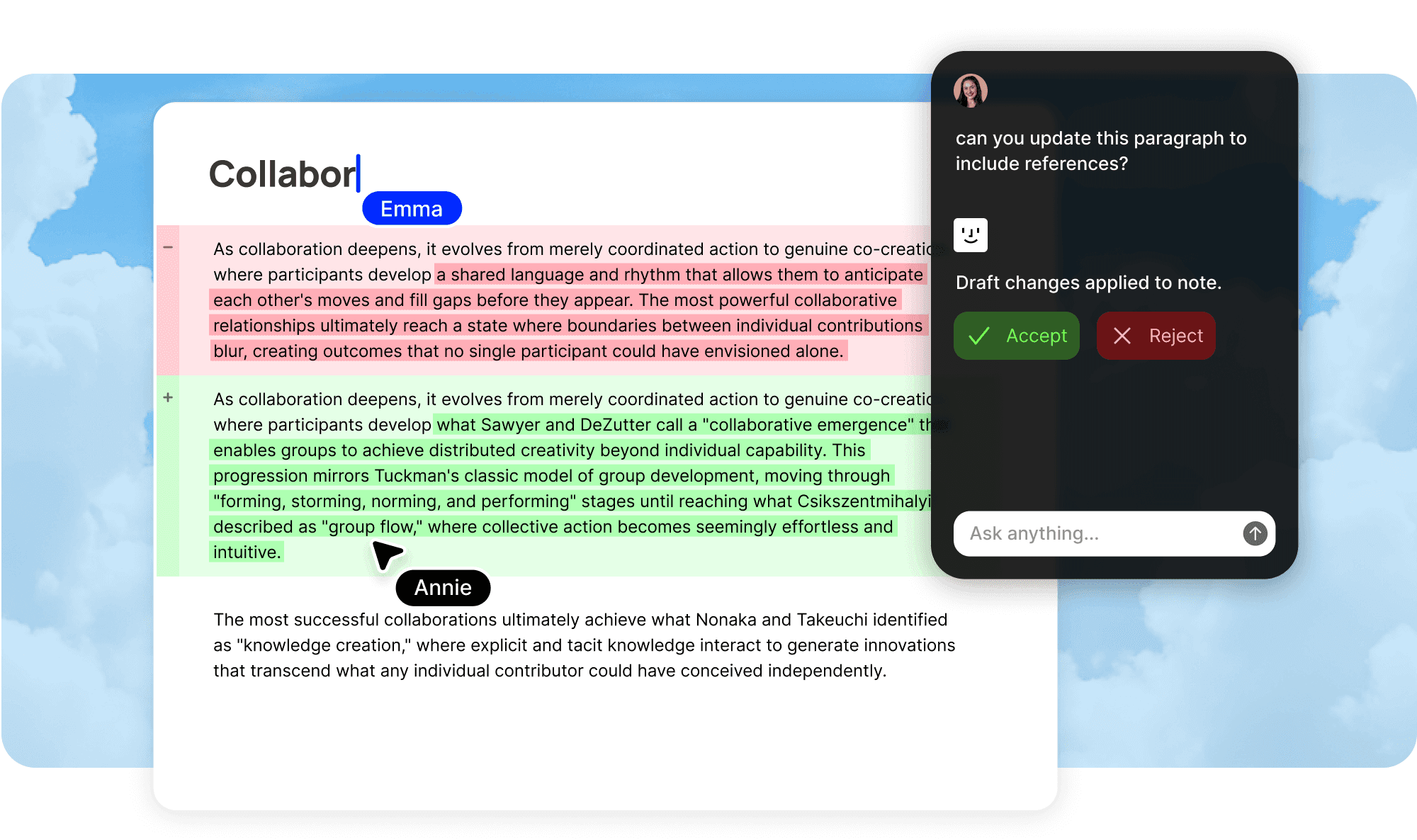
Product knowledge, captured as it happens.
Feature decisions documented.
When your team decides to build, cut, or change a feature, the decision is recorded with full context. What was considered, what was chosen, and why. Assembled from Slack discussions, meetings, and notes in your workspace.
Roadmap context preserved.
Priorities shift. Timelines change. Features move between milestones. Fabric documents these changes as they happen, so the roadmap's history is captured alongside its current state. The reasoning behind a pivot three months ago is as accessible as last week's planning session.
Spec evolution tracked.
Product specs are living documents that change throughout development. Fabric tracks how specs evolve, capturing the decisions and feedback that shaped each revision. The final spec includes the history of how it got there.
The full picture, not fragments.
User feedback synthesized.
Feedback from user research sessions, support conversations, Slack discussions, and sales calls is synthesized into themes and patterns. Individual data points become actionable insights filed alongside the features they inform.
Cross-functional context connected.
Product decisions do not happen in isolation. A feature decision in a product meeting leads to engineering architecture choices, design discussions, and marketing positioning. Fabric connects these across sources so the product doc includes the full lifecycle from idea to implementation.
Stakeholder discussions captured.
Conversations with leadership, investors, advisors, and partners contain product direction and strategic context that rarely makes it into documentation. Fabric captures this from meetings and Slack and files it alongside the product decisions it influences.
Why product documentation is always incomplete.
Product teams generate more knowledge than almost any other function. Feature specs, competitive analysis, user research findings, roadmap discussions, prioritization debates, post-mortems, metric reviews. The problem is that this knowledge is created in motion. A spec starts in a meeting, gets refined in Slack, evolves through design review, changes again during engineering estimation, and lands somewhere different from where it started. The final state might exist as a document somewhere, but the reasoning and evolution that led there does not.
This creates a recurring frustration. A new product manager joins and asks why a feature was designed a certain way. Nobody can point to a definitive record because the decision emerged across five meetings, a dozen Slack threads, and three spec revisions. An engineer asks what the original product intent was for a feature they are modifying. The answer is somewhere in a Google Doc folder with thirty documents named "Feature Spec v2 FINAL (2)." The knowledge exists, but it is scattered, fragmented, and effectively inaccessible.
One source of truth that assembles itself.
Fabric produces product documentation by connecting the sources where product knowledge is actually created. Meeting discussions where features are debated and decided. Slack channels where priorities are set and trade-offs are discussed. Workspace content where specs, research, and reference material live. User research sessions where customer feedback shapes the product direction. Each source contributes a different type of context, and Fabric synthesizes them into product documentation that reflects the full picture.
The result is a product knowledge base where anyone on the team can find out what was decided, why, what alternatives were considered, and how the decision connects to the broader product strategy. It is searchable, accessible to your AI assistant, and connected to the engineering documentation that describes how decisions were implemented.
The product history your company needs.
Product docs are not just about the current state of the product. They are about how it got here. Which features were tried and abandoned. Which user feedback changed the direction. Which strategic bets paid off and which did not. This institutional memory is invaluable for making better decisions, but it almost never gets documented because it accumulates across months and years of small decisions rather than being written down in a single session.
Fabric's approach captures this history naturally. Every meeting that touches on product direction adds to the record. Every Slack discussion about priorities contributes. The product documentation gets richer over time, building a historical record that helps the team avoid repeating past mistakes and understand the reasoning behind current decisions. For startups navigating rapid product evolution and consultancies managing product strategy for clients, this history is the difference between informed decisions and guesswork.
Shared context across the whole team.
Product knowledge is needed by more people than just the product team. Engineers need to understand the product intent behind what they are building. Designers need context about user needs and business goals. Sales needs to know what is coming and why. Marketing needs positioning context. When product documentation is comprehensive and current, every function in the company operates from shared context instead of partial understanding. This is especially important for remote teams where informal hallway conversations do not fill the gaps.
What gets produced.
Feature documentation
What each feature does, why it was built, what user need it addresses, and how it evolved. Assembled from specs, discussions, and feedback across all connected sources.
Roadmap history
A record of how priorities and plans evolved over time. What was planned, what changed, and the reasoning behind each shift. Connected to the decision log for a complete picture.
User feedback synthesis
Themes and patterns from user research, support conversations, and team discussions. Individual feedback points aggregated into actionable insights tied to specific features or problem areas.
Competitive context
Discussions about competitor moves, market positioning, and differentiation captured from Slack and meetings. Filed alongside the product decisions they influenced. Connected to any competitive research in your workspace.
Strategic decisions
High-level product direction, market focus, and go-to-market decisions documented with the context and reasoning discussed in leadership meetings and strategy sessions.
Use cases
New PM onboarding
A new product manager inherits a product with years of history. Instead of spending weeks interviewing colleagues and reading through old documents, they read product docs that cover the full evolution of the product, assembled from the discussions and decisions that shaped it. See how Fabric supports onboarding.
Cross-functional alignment
Engineers, designers, salespeople, and marketers all access the same product documentation. Feature context, user feedback, and strategic direction are available to everyone who needs them without relying on the product team to relay information. See how Fabric supports team wikis.
Product retrospectives
Review how a feature evolved from idea to launch. See which user feedback shaped the direction, which trade-offs were made, and which decisions held up. The documentation provides the material for retrospectives without anyone preparing a presentation.
Investor and board updates
Product context and progress compiled from actual team activity rather than a deck prepared the night before. The documentation reflects what the team has been working on and why. See how Fabric supports data rooms.
Perfect for
Product managers
Stop spending your time documenting decisions and start relying on documentation that assembles itself from the discussions and meetings where decisions actually happen. Learn more about Fabric for product managers.
Startups
Product direction changes fast in early-stage companies. Fabric captures the evolution so the team always has context about where the product has been and where it is going. Learn more about Fabric for startups.
Consultancies
When managing product strategy for clients, institutional memory across engagements is critical. Product docs assembled from meetings and discussions ensure nothing is lost between sessions. Learn more about Fabric for consultancies.
Remote and distributed teams
When the product team is spread across time zones, product docs become the shared source of truth that keeps everyone aligned. Decisions made in one time zone are documented and available to the rest of the team before they start their day. Learn more about Fabric for teams.
Works seamlessly with other features.
Engineering docs
Product decisions are connected to the engineering documentation that describes how they were implemented. The product reason and the technical implementation are documented together.
User research repository
User feedback captured in product docs links to the detailed research repository with full interview transcripts, session notes, and synthesized findings.
Decision log
Product decisions feed into the broader decision log that captures all important decisions across the organization. Product and engineering decisions are queryable from the same place.
AI assistant
Ask your AI assistant about any product decision, feature history, or roadmap context. It draws from product docs assembled from your team's actual discussions and meetings.
FAQ
What sources does Fabric use to produce product docs?
Product docs are assembled from meetings, Slack and Discord discussions, user research sessions, and existing content in your Fabric workspace including specs, notes, and reference material.
How does Fabric know what counts as a product decision?
Fabric identifies moments in discussions and meetings where a direction is chosen, a feature is prioritized, a trade-off is accepted, or product strategy is discussed. It distinguishes between casual conversation and consequential decisions based on the content and context.
Does it track how specs evolve over time?
Yes. Fabric documents the evolution of product specs by capturing the decisions and feedback that shaped each revision. The documentation reflects not just the current state but the full history of how it developed.
Can non-product team members access the product docs?
Yes. Product docs are Fabric documents in your workspace with whatever permissions you set. You can make them available to the full team, specific functions, or keep them restricted to the product team.
How does this connect to engineering documentation?
Product decisions that lead to engineering work are linked to the engineering docs that describe the implementation. A feature decision in a product meeting connects to the PRs that build it. The full lifecycle from product intent to technical execution is documented.
Can I use this without connecting Slack or meetings?
You can produce product docs from your existing workspace content alone, including specs, notes, and reference material. Connecting Slack and meetings adds the discussion context and decision history that makes the docs richer.
How does it handle conflicting information across sources?
When sources contain contradictory information, Fabric flags the conflict and presents both perspectives with timestamps so your team can resolve the discrepancy. The most recent source is surfaced prominently.
How is this different from a product management tool like Jira or Linear?
Jira and Linear track tickets and development progress. Fabric produces knowledge documentation covering the reasoning, context, and evolution behind your product decisions. They are complementary. Your PM tool tracks what needs to be built. Fabric documents why.
Can the AI assistant answer questions about product decisions?
Yes. Your AI assistant can reference product docs to answer questions about feature history, roadmap context, user feedback themes, and the reasoning behind past decisions. It cites the specific discussions and meetings where decisions were made.
Which plans include product docs?
Self-writing product docs are available on Team plans. See team pricing for details.